
Grooming gift sets for men combine everyday personal-care products in a coordinated package. Depending on the recipient, a set might include shaving cream, beard oil, face wash, moisturizer, hair products, body care, fragrance, tools, or travel accessories. The strongest gift is not necessarily the largest or most luxurious box. It is the one that fits the recipient’s routine, skin type, grooming habits, and comfort with scented products.
This guide explains how to compare men’s grooming sets, choose suitable ingredients and tools, and adapt the gift for birthdays, anniversaries, holidays, or professional occasions. It also covers practical limitations, neutral pros and cons, personalization options, and ways to avoid buying a polished-looking kit that will remain unused.
What Is a Men’s Grooming Gift Set?
A men’s grooming gift set is a collection of personal-care products or grooming tools packaged and sold, or assembled by the giver, as one gift. Sets may focus on a single routine, such as shaving or beard care, or cover several categories, such as skin, hair, body, and fragrance.
Common types include:
- Shaving sets: shaving cream or soap, a razor, a brush, post-shave balm, and sometimes a bowl or stand.
- Beard-care sets: beard wash, oil, balm, a comb, scissors, or a brush.
- Skin-care sets: cleanser, moisturizer, sunscreen, serum, or exfoliating products.
- Hair-styling sets: shampoo, conditioner, pomade, clay, cream, or styling tools.
- Body-care sets: body wash, soap, deodorant, hand cream, or lotion.
- Travel sets: compact containers, a toiletry bag, and portable versions of daily products.
- Tool-based sets: beard trimmers, electric shavers, nose and ear trimmers, nail tools, or cleaning accessories.
The term can describe a ready-made retail box or a handmade gift assembled from individually selected items. A custom version often gives the buyer more control over ingredients, product sizes, scent, packaging, and budget.
How to Choose Grooming Gift Sets for Men
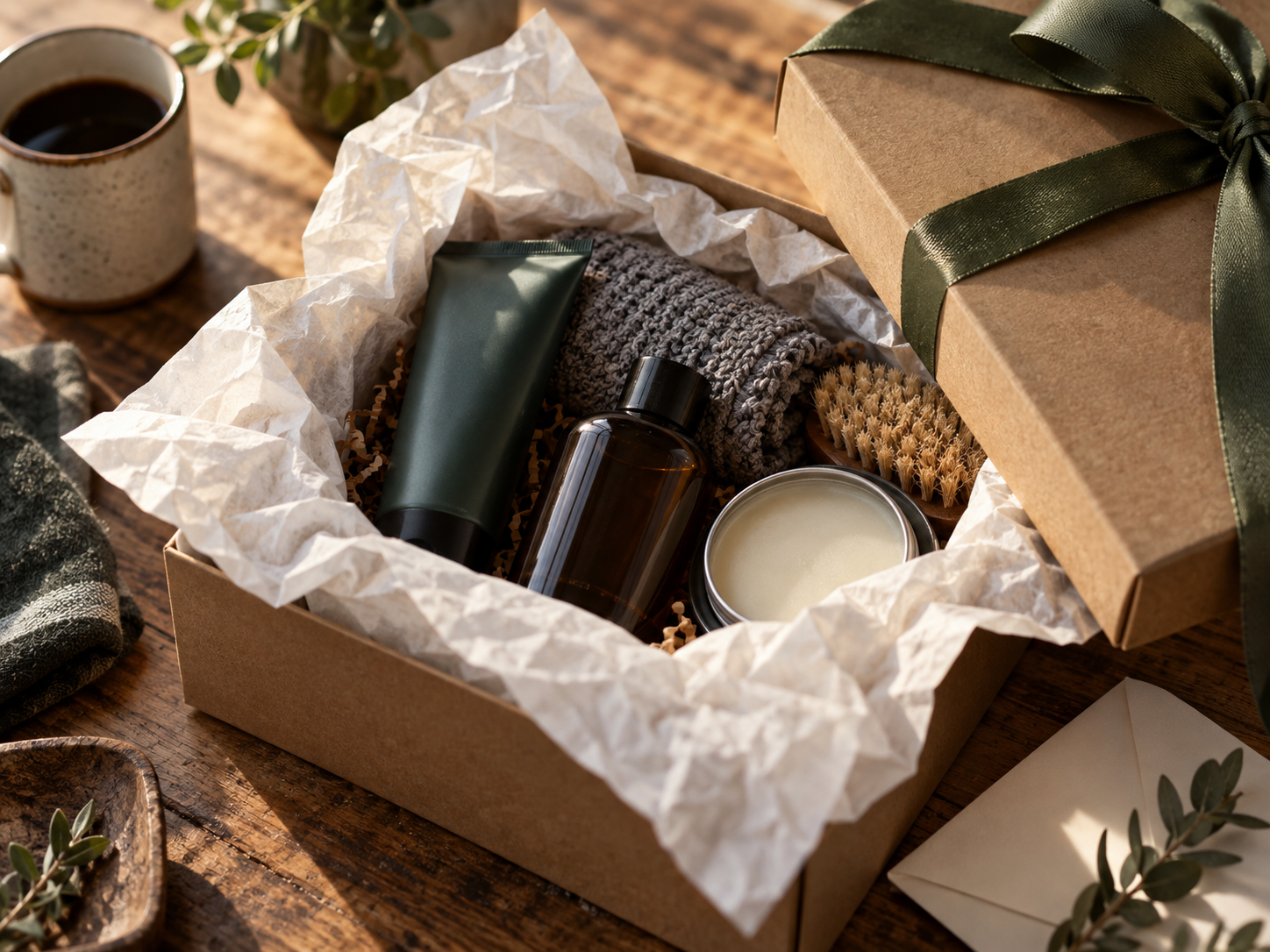
1. Start With the Recipient’s Existing Routine
Look for evidence of what the recipient already uses. A clean-shaven person may appreciate a high-quality shaving set, while someone with a full beard is more likely to use beard wash, oil, and a durable comb. A frequent traveler may value a compact toiletry kit more than a large collection of full-size containers.
Avoid treating grooming as a problem that the gift is meant to correct. Products aimed at hair loss, acne, body odor, or signs of aging can feel overly personal unless the recipient has specifically requested them. A neutral set built around comfort and routine is usually more appropriate.
2. Check Skin and Hair Compatibility
Labels such as “for men” do not establish whether a product is suitable for an individual’s skin. Review the ingredient list and product instructions rather than relying on gendered packaging. For sensitive skin, simpler formulas and fragrance-free options may be easier to introduce than sets containing several strongly scented products.
The American Academy of Dermatology advises testing a skin-care product on a small area before broader use when there is concern about a reaction. The U.S. Food and Drug Administration also explains that cosmetic labels generally list ingredients in descending order of predominance, subject to specific labeling rules. These sources are useful when comparing formulas, although neither can predict how a particular person will respond.
3. Choose a Scent Carefully
Fragrance is one of the biggest uncertainties in grooming gifts. Terms such as woody, marine, fresh, smoky, or citrus describe broad scent families, not a guaranteed experience. A heavily fragranced set can also conflict with the recipient’s usual cologne or workplace preferences.
If you do not know what the person likes, select fragrance-free products or a set with a mild, familiar scent. Avoid assuming that luxury packaging makes a fragrance universally appealing. For an anniversary gift, a known favorite scent can make the set feel personal without requiring an elaborate custom product.
4. Prefer a Focused Set Over Unnecessary Variety
A compact set with three compatible products may be more useful than a box containing many overlapping items. For example, a beard wash, beard oil, and comb form a clear routine. A cleanser, basic moisturizer, and broad-spectrum sunscreen can support a simple skin-care routine, provided the products suit the recipient.
Focused sets also make instructions easier to follow and reduce waste. This matters when choosing eco-friendly gifts, since excessive packaging and unused products can outweigh benefits claimed for recyclable boxes or natural-looking materials.
5. Evaluate Tools and Tech Gadgets Separately
Electric grooming tools require more scrutiny than soaps or creams. Check the plug type, voltage requirements, charging method, replacement parts, cleaning process, warranty, and whether the tool is designed for wet use, dry use, or both. A rechargeable trimmer may be convenient, but a proprietary charging cable can become a limitation if it is lost.
For air travel, battery and liquid rules can vary by item and destination. The U.S. Transportation Security Administration publishes current guidance for liquids, aerosols, gels, razors, and batteries in carry-on and checked baggage. Travelers should check the relevant airline and national authority before packing.
A Practical Comparison Method
Because grooming sets vary widely, comparisons should use consistent criteria rather than package size or marketing language. A useful method is to score each candidate informally across six areas:
- Relevance: Does every product support a routine the recipient already follows or wants to begin?
- Compatibility: Are the formulas appropriate for known skin, hair, fragrance, or allergy considerations?
- Usability: Are the instructions clear, containers practical, and tools easy to clean or recharge?
- Replacement: Can frequently used products, blades, heads, or accessories be purchased separately?
- Packaging: Is the presentation gift-ready without creating excessive waste?
- Value: Are you paying for useful contents rather than duplicate products, decorative filler, or a large box?
This methodology avoids claims based on unverified tests or temporary prices. Product formulas, packaging, and availability can change, so confirm the current label and manufacturer’s documentation before purchasing.
Matching the Set to the Occasion
Birthday Gifts
For a birthday, match the kit to a visible interest or established habit. A beard-care box suits someone who takes pride in maintaining facial hair, while a travel grooming organizer works for a frequent traveler. Personalized gifts can add meaning: consider an engraved comb, monogrammed toiletry bag, or reusable tag. Keep the customization separate from consumable products so it remains useful after the original items are finished.
Anniversary Gifts
An anniversary set can feel more intimate, but it should still reflect the recipient’s preferences. Pair a familiar fragrance or shaving product with a durable accessory, such as a quality wash bag. Avoid selecting a new perfume solely because its description sounds romantic; scent is subjective, and returns may be restricted after opening.
Holiday Gift Guides
Holiday gift guides often sort grooming products by broad identities such as “the traveler” or “the minimalist.” Use those labels only as a starting point. Compare the actual contents, sizes, and return conditions. Seasonal packaging can be attractive, but it does not necessarily indicate different or better formulas than standard products.
Corporate Gifting
Corporate gifts should be neutral, inclusive, and easy to distribute. A strongly fragranced shaving set may assume too much about an employee’s body, grooming choices, culture, or personal style. A simple travel organizer, hand-care kit, or opt-in gift selection is often more appropriate. Employers should also follow internal policies on gift values, branding, accessibility, and conflicts of interest.
Personalized, Handmade, and Luxury Options
Personalization can range from a name on the case to a fully assembled routine. Before engraving an item, verify spelling and understand that customized goods may not be returnable. Subtle initials are often more versatile than prominent text or a novelty message.
A handmade gift can combine products from several makers, but handcrafted does not automatically mean safer, more sustainable, or higher quality. Check ingredient labels, shelf-life guidance, storage instructions, and seller contact information. Homemade cosmetics are a poor choice when the formulation, preservation, or hygiene controls are unknown.
Luxury gifts should be judged by material quality, formula transparency, construction, refill availability, and service rather than brand prestige alone. A well-made tool that can be cleaned and maintained may offer longer use than an elaborate box dominated by miniature products. Conversely, premium creams and fragrances may not justify their cost if the recipient has no interest in changing products.
Pros and Cons
Potential Advantages
- A coordinated set makes it easier to try a complete routine.
- Gift packaging can reduce the time needed to assemble and present separate items.
- Travel sizes may help the recipient test products before committing to replacements.
- A tailored kit can show attention to the recipient’s habits and preferences.
- Tools, bags, brushes, and combs can remain useful after consumable products run out.
Potential Disadvantages
- Fragrance, texture, and skin compatibility are highly personal.
- Sets may include filler items or duplicates that reduce practical value.
- Miniatures can create more packaging waste relative to the amount of product.
- Opened cosmetics and personalized items may have limited return options.
- Electric tools can require replacement heads, batteries, special chargers, or ongoing maintenance.
Limitations to Consider
A grooming set cannot guarantee better skin, hair, or shaving results. Outcomes depend on technique, consistency, individual biology, environmental conditions, and the suitability of each product. Cosmetic products are not substitutes for diagnosis or treatment of persistent irritation, infection, severe acne, sudden hair loss, or other medical concerns.
Claims such as “natural,” “clean,” and “eco-friendly” can be broad or inconsistently defined. Review specific evidence, including packaging materials, refill options, shipping distance, ingredient sourcing, and disposal instructions. The U.S. Federal Trade Commission’s Green Guides provide a useful framework for understanding environmental marketing claims, but local recycling rules still determine whether a package is accepted.
Availability also matters. A set built around limited-edition products may be difficult to replenish. For electric devices, discontinued blades or attachments can shorten the useful life of an otherwise functional tool.
How to Build a Custom Grooming Gift Set
- Select one routine. Choose shaving, beard care, basic skin care, hair styling, body care, or travel rather than mixing unrelated products.
- Add two or three essentials. Use products that work in sequence, such as cleanser, moisturizer, and sunscreen or beard wash, oil, and comb.
- Include one durable item. A toiletry bag, brush, comb, stand, mirror, or washable cloth gives the gift a longer life.
- Review every label. Check ingredients, warnings, expiration or period-after-opening symbols, storage guidance, and usage directions.
- Reduce packaging. Use a reusable bag or box and avoid plastic filler where practical.
- Keep proof of purchase. Retain receipts and avoid removing seals in case the recipient needs an exchange.
- Add a short note. Explain why the items were selected without implying that the recipient needs to change his appearance.
For an experience gift, a barber appointment, traditional wet-shaving lesson, or skin-care consultation can accompany the kit. Confirm the provider’s services, cancellation policy, accessibility, and whether the recipient is comfortable with close-contact treatments before booking.
Concise Q&A
Are grooming gift sets suitable for men who do not have a beard?
Yes. Consider shaving, hair care, body care, hand care, skin care, fragrance-free products, or a travel kit. The contents should follow the person’s routine rather than a generic idea of men’s grooming.
Is a more expensive set always better?
No. Price can reflect branding, packaging, ingredients, tool construction, or retail positioning. Compare usefulness, formula suitability, replacement options, and build quality instead of assuming that cost predicts fit.
What is the safest choice when skin type is unknown?
A small, fragrance-free set with a clear ingredient list is generally easier to evaluate, but no cosmetic is universally reaction-free. Include a gift receipt and encourage label review and patch testing according to product directions.
Can grooming sets be eco-friendly?
They can reduce waste through refillable containers, durable tools, minimal packaging, and products the recipient will actually use. Verify concrete packaging and disposal details rather than relying only on broad environmental labels.
What should be avoided in a corporate grooming gift?
Avoid intimate problem-focused products, strong fragrances, assumptions about facial hair, and items that conflict with company gift policies. An opt-in selection among several practical gifts is more inclusive.
Final Checklist
Before choosing grooming gift sets for men, confirm the recipient’s routine, scent preference, skin considerations, travel needs, and willingness to try something new. Read current labels, inspect tool requirements, compare replacement availability, and review the return policy. A modest, coherent kit with useful contents is usually a stronger gift than an oversized collection chosen mainly for presentation.
Safety and informational disclaimer: This article provides general gift-selection information, not medical advice. Follow product warnings and device instructions, stop using any item that causes irritation, and seek qualified medical guidance for persistent or severe symptoms. Check current transport rules before traveling with blades, liquids, aerosols, or batteries.
Leave a Reply